
THEMATIC AND EXTENDED ACCOUNTS
Online Inventory
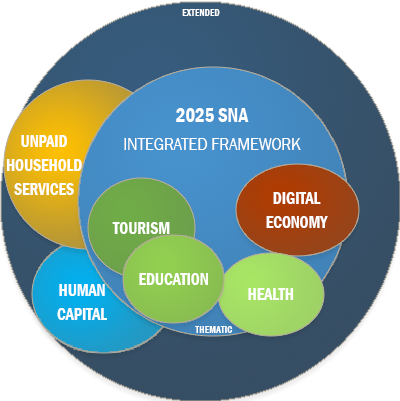
This online inventory presents to national compilers easy reference to available examples of thematic and extended accounts published by countries. It provides links to country-specific sources and methods as well as available international guidance in these areas. The inventory was developed following an in-depth review of satellite accounting carried out by the Bureau of the Conference of the European Statisticians (CES). It is updated annually by UNECE.
The integrated framework of the System of National Accounts, 2025 (2025 SNA) is a powerful analytical tool containing a rich set of information. However, to present a clear overview of the main economic aggregates it provides relatively limited amount of disaggregation. Often the information from the integrated framework needs to be further detailed, re-packaged, or expanded to address more specific policy questions.
Thematic and Extended Accounts (formerly Satellite Accounts) enhance visibility of key phenomena and provide the flexibility to look outside the rigours of the core concepts and methods, while at the same time keep overall coherence with the SNA conceptual framework.
Thematic accounts stay within the boundaries of the integrated SNA framework but provide more detail or alternative aggregations of specific activities. Extended accounts expand the boundaries of the framework with respect to production, consumption, income or assets.
Chapter 38 of the 2025 SNA outlines the roles of thematic and extended accounts and provides guidelines for compiling thematic accounts. In addition Chapter 34 and Chapter 35 propose several such accounts to complement the core framework, offering insights into well-being and sustainability.
If you have any comments or corrections concerning the information on your country presented in the online inventory please contact us at national.accounts[at]un.org

The System of Environmental Economic Accounting (SEEA) is the statistical standard for measuring the environment and its relationship with the economy. There are two parts of the SEEA, the SEEA Central Framework and the SEEA Ecosystem Accounting. Both the Central Framework and Ecosystem Accounting include accounts in physical and monetary terms. In addition, the SEEA makes it possible to further identify monetary information related to the environment which is already included in the SNA. By applying the same accounting rules, definitions and classifications as the System of National Accounts to environmental data, the SEEA complements the SNA by providing an integrated framework that measures the interrelationships between the economy and the environment. The development and implementation of the SEEA is undertaken by the UN Committee of Experts on Environmental Economic Accounting (UNCEEA). The data presented are taken from the Global Assessment of Environmental-Economic Accounting and Supporting Statistics which is carried out annually by UNSD under the auspices of the UNCEEA to monitor the implementation of the SEEA and to report on SDG indicator 15.9.1b. For further information please see SEEA Around the World | System of Environmental Economic Accounting